All posts
Benchmarks · 13 min read
Nextflow Frontier outscored Rosalind and Claude Science on BioML-bench
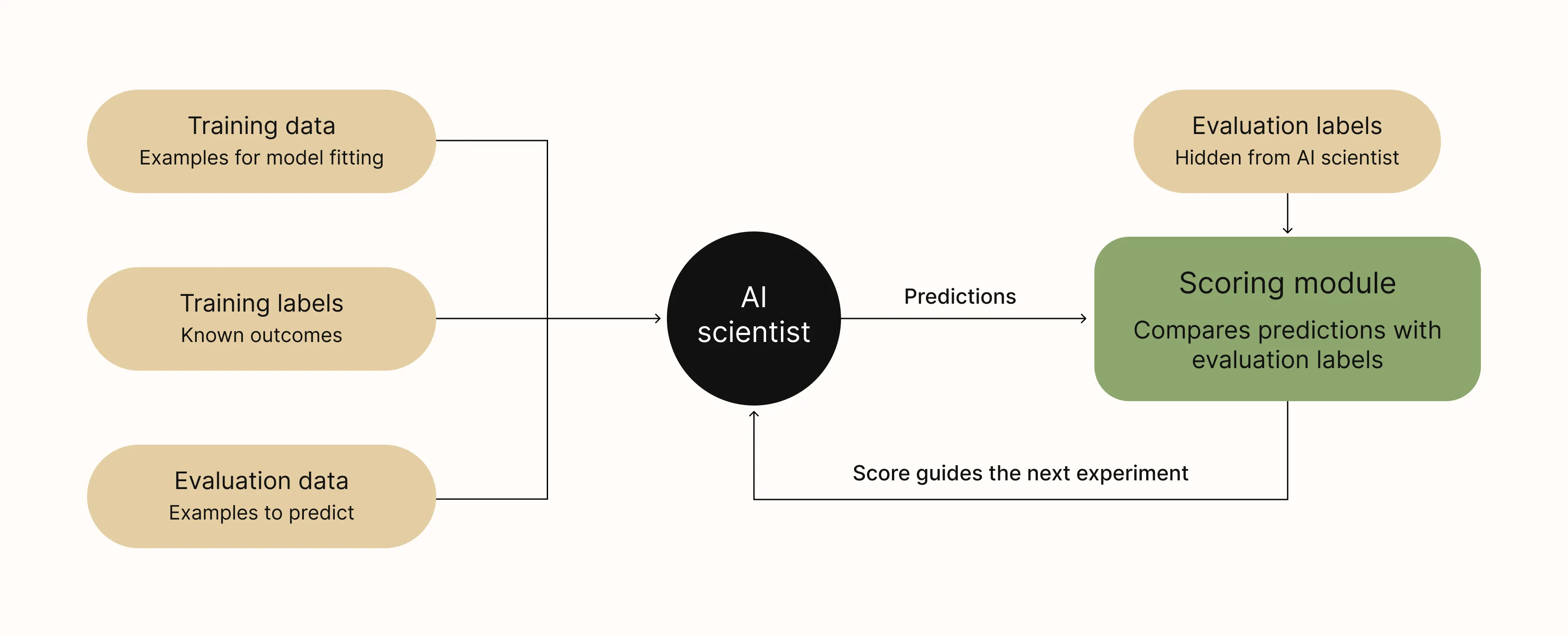
We ran Nextflow Frontier against OpenAI's Rosalind and Anthropic's Claude Science on the same 22 tasks from BioML-bench, a public benchmark for biomedical machine learning. Nextflow Frontier ranked at the 96th percentile of each task's public leaderboard on average, against the 68th for Rosalind and the 69th for Claude Science.
By Nextflow Frontier Team
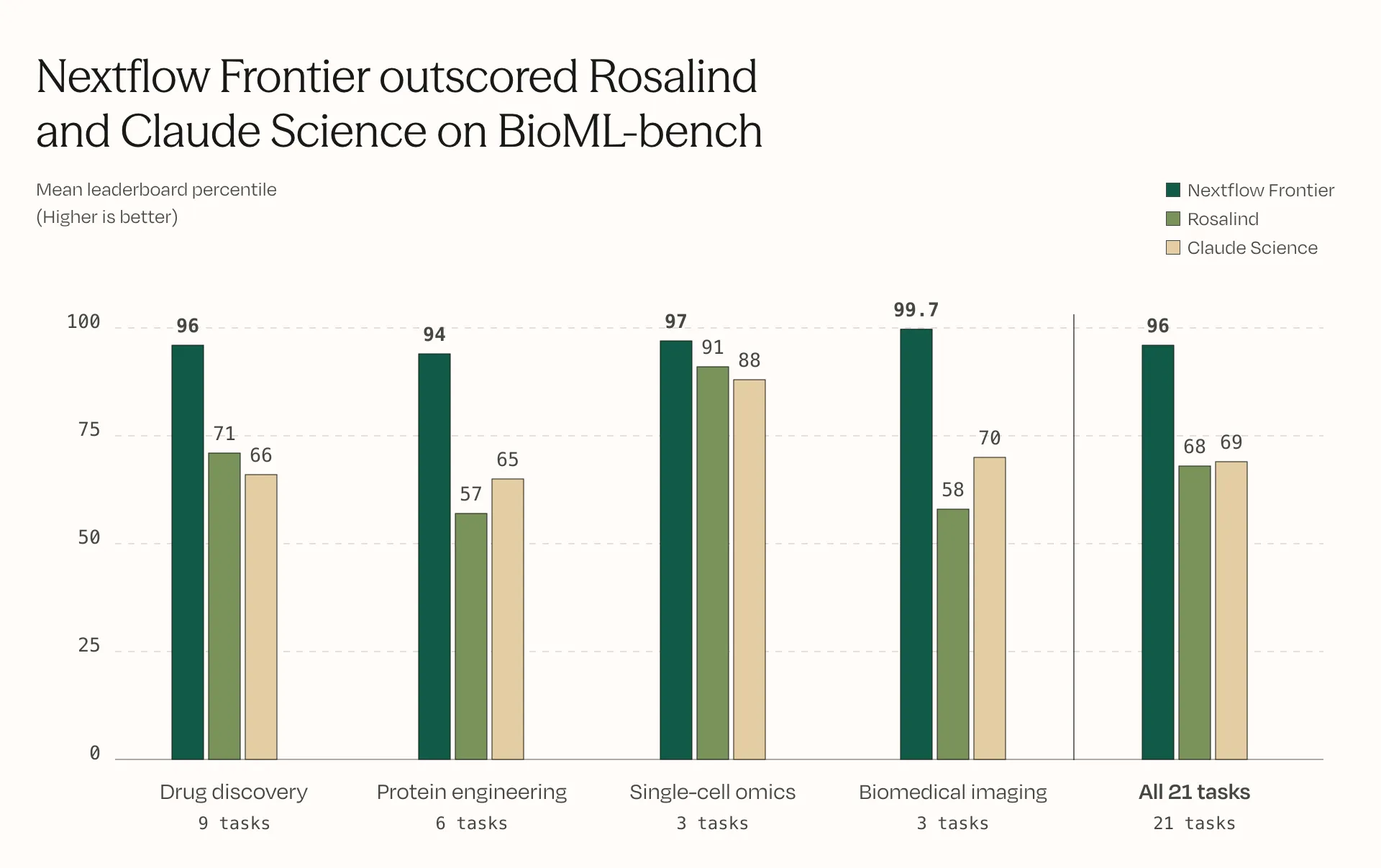
Models improve through experiments
Building a machine learning model for a biological problem takes many rounds of experiments. A researcher picks how to describe the data and which model to fit, scores the result on examples the model has not seen, and lets that score decide what to try next.
That loop is the design principle behind Nextflow Frontier, the closed-loop discovery system built and recently launched by the team that created Nextflow. Nextflow Frontier’s agents research a task, write code for each experiment, run it, read the scores and plan the next set of experiments from what they learned. It often runs hundreds of experiments in parallel, for days.
Each cycle of this loop would normally cost a computational scientist days; Nextflow Frontier runs hundreds of rounds in parallel, unsupervised if the scientists so choose, so teams can run a comprehensive set of experiments and leave with a view to leaving no possible solution path unexplored.
We ran Nextflow Frontier against the AI scientists from OpenAI and Anthropic, with the same fundamental parameters and the same freedom to keep experimenting, and measured how each scored.
Benchmark setup
We evaluated Nextflow Frontier, Rosalind and Claude Science on BioML-bench (Miller et al. 2025), a set of 24 tasks in drug discovery, protein engineering, single-cell omics and biomedical imaging, each with a public leaderboard.
We chose to report rank percentiles (e.g. 96 means a system is better than 96% of prior submitted methods on that task).
Nextflow Frontier ranked highest in every area
Nextflow Frontier matched or outperformed both Rosalind and Claude Science on all scored tasks, and it scored above every public leaderboard entry 71% of the time.
| Task area | Nextflow Frontier | Rosalind | Claude Science |
|---|---|---|---|
| Drug discovery (9 tasks) | 96 | 71 | 66 |
| Protein engineering (6 tasks) | 94 | 57 | 65 |
| Single-cell omics (3 tasks) | 97 | 91 | 88 |
| Biomedical imaging (3 tasks) | 99.7 | 58 | 70 |
| All tasks (21 tasks) | 96 | 68 | 69 |
Six of eight ties (75%) occurred at the 100th percentile, where Nextflow Frontier, Claude Science or Rosalind beat every public leaderboard entry, leaving no room for the percentile to distinguish their scores. The remaining ties were on perturbation response, at the 90th percentile, and histopathology, at 99.2.
Days of search versus minutes
Nextflow Frontier is built to run as long as a problem requires. This extreme scale of test-time compute, the computing a system spends while working on a task, is made possible by custom algorithms built to escape local minima and optimize compute utilization. As a result, Nextflow Frontier developed and tested more refined and varied approaches than Rosalind or Claude Science on all 22 tasks.
For comparison, Nextflow Frontier ran longer than Rosalind or Claude Science on all 22 compared tasks. Its shortest search, 11 hours on GI tract segmentation, was about four times as long as the longest run by either Anthropic’s or OpenAI’s system: Claude Science’s 2.8 hours on the same task.
Nextflow Frontier also scored far more attempts. Its median was 520 attempts per task whereas Rosalind’s and Claude Science’s was 41.5 and 2, respectively.
| Measure | Task | System | Value |
|---|---|---|---|
| Search time per task | Hepatic clearance | Rosalind | 13.2 minutes |
| Search time per task | Hepatic clearance | Claude Science | 22.9 minutes |
| Search time per task | Plasma protein binding | Rosalind | 8.4 minutes |
| Search time per task | Plasma protein binding | Claude Science | 9.2 minutes |
| Search time per task | Solubility | Rosalind | 9.1 minutes |
| Search time per task | Solubility | Claude Science | 3 minutes |
| Search time per task | EGFR kinase activity | Rosalind | 3.3 minutes |
| Search time per task | EGFR kinase activity | Claude Science | 8.1 minutes |
| Search time per task | Blood-brain barrier | Rosalind | 7.1 minutes |
| Search time per task | Blood-brain barrier | Claude Science | 3.1 minutes |
| Search time per task | Caco-2 permeability | Rosalind | 9.8 minutes |
| Search time per task | Caco-2 permeability | Claude Science | 31.1 minutes |
| Search time per task | CYP2D6 substrate | Rosalind | 7.7 minutes |
| Search time per task | CYP2D6 substrate | Claude Science | 22.8 minutes |
| Search time per task | hERG blockade | Rosalind | 7.3 minutes |
| Search time per task | hERG blockade | Claude Science | 37 minutes |
| Search time per task | Lipophilicity | Rosalind | 8.9 minutes |
| Search time per task | Lipophilicity | Claude Science | 44.5 minutes |
| Search time per task | CBX4 stability | Rosalind | 4.8 minutes |
| Search time per task | CBX4 stability | Claude Science | 3.4 minutes |
| Search time per task | CSN4 indels | Rosalind | 5.4 minutes |
| Search time per task | CSN4 indels | Claude Science | 5.8 minutes |
| Search time per task | PsaE stability | Rosalind | 10.6 minutes |
| Search time per task | PsaE stability | Claude Science | 33.3 minutes |
| Search time per task | Q8EG35 indels | Rosalind | 4.7 minutes |
| Search time per task | Q8EG35 indels | Claude Science | 26.1 minutes |
| Search time per task | Sbi stability | Rosalind | 8.6 minutes |
| Search time per task | Sbi stability | Claude Science | 7.8 minutes |
| Search time per task | SARS-CoV-2 spike binding | Rosalind | 5.9 minutes |
| Search time per task | SARS-CoV-2 spike binding | Claude Science | 32.1 minutes |
| Search time per task | Label projection | Rosalind | 10 minutes |
| Search time per task | Label projection | Claude Science | 13.1 minutes |
| Search time per task | Predict modality | Rosalind | 22.6 minutes |
| Search time per task | Predict modality | Claude Science | 13.9 minutes |
| Search time per task | Perturbation response | Rosalind | 19.1 minutes |
| Search time per task | Perturbation response | Claude Science | 6 minutes |
| Search time per task | Histopathology cancer | Rosalind | 26.5 minutes |
| Search time per task | Histopathology cancer | Claude Science | 105.6 minutes |
| Search time per task | Pulmonary fibrosis | Rosalind | 7.5 minutes |
| Search time per task | Pulmonary fibrosis | Claude Science | 2.3 minutes |
| Search time per task | Brain tumor MGMT | Rosalind | 10.4 minutes |
| Search time per task | Brain tumor MGMT | Claude Science | 4.4 minutes |
| Search time per task | GI tract segmentation | Rosalind | 21.3 minutes |
| Search time per task | GI tract segmentation | Claude Science | 166.3 minutes |
| Search time per task | EGFR kinase activity | Nextflow Frontier | 4824 minutes |
| Search time per task | Plasma protein binding | Nextflow Frontier | 2634 minutes |
| Search time per task | Solubility | Nextflow Frontier | 14646 minutes |
| Search time per task | Lipophilicity | Nextflow Frontier | 2394 minutes |
| Search time per task | hERG blockade | Nextflow Frontier | 3768 minutes |
| Search time per task | Blood-brain barrier | Nextflow Frontier | 7560 minutes |
| Search time per task | Caco-2 permeability | Nextflow Frontier | 3696 minutes |
| Search time per task | Hepatic clearance | Nextflow Frontier | 4698 minutes |
| Search time per task | CYP2D6 substrate | Nextflow Frontier | 3738 minutes |
| Search time per task | Sbi stability | Nextflow Frontier | 6852 minutes |
| Search time per task | CSN4 indels | Nextflow Frontier | 2100 minutes |
| Search time per task | CBX4 stability | Nextflow Frontier | 7560 minutes |
| Search time per task | PsaE stability | Nextflow Frontier | 13992 minutes |
| Search time per task | Q8EG35 indels | Nextflow Frontier | 1866 minutes |
| Search time per task | SARS-CoV-2 spike binding | Nextflow Frontier | 1356 minutes |
| Search time per task | Predict modality | Nextflow Frontier | 1680 minutes |
| Search time per task | Perturbation response | Nextflow Frontier | 9984 minutes |
| Search time per task | Label projection | Nextflow Frontier | 3684 minutes |
| Search time per task | Pulmonary fibrosis | Nextflow Frontier | 10548 minutes |
| Search time per task | Histopathology cancer | Nextflow Frontier | 1806 minutes |
| Search time per task | Brain tumor MGMT | Nextflow Frontier | 2946 minutes |
| Search time per task | GI tract segmentation | Nextflow Frontier | 660 minutes |
| Attempts scored by the grader, per task | Hepatic clearance | Rosalind | 83 |
| Attempts scored by the grader, per task | Hepatic clearance | Claude Science | 2 |
| Attempts scored by the grader, per task | Plasma protein binding | Rosalind | 93 |
| Attempts scored by the grader, per task | Plasma protein binding | Claude Science | 2 |
| Attempts scored by the grader, per task | Solubility | Rosalind | 37 |
| Attempts scored by the grader, per task | Solubility | Claude Science | 1 |
| Attempts scored by the grader, per task | EGFR kinase activity | Rosalind | 51 |
| Attempts scored by the grader, per task | EGFR kinase activity | Claude Science | 2 |
| Attempts scored by the grader, per task | Blood-brain barrier | Rosalind | 230 |
| Attempts scored by the grader, per task | Blood-brain barrier | Claude Science | 2 |
| Attempts scored by the grader, per task | Caco-2 permeability | Rosalind | 88 |
| Attempts scored by the grader, per task | Caco-2 permeability | Claude Science | 2 |
| Attempts scored by the grader, per task | CYP2D6 substrate | Rosalind | 175 |
| Attempts scored by the grader, per task | CYP2D6 substrate | Claude Science | 2 |
| Attempts scored by the grader, per task | hERG blockade | Rosalind | 32 |
| Attempts scored by the grader, per task | hERG blockade | Claude Science | 2 |
| Attempts scored by the grader, per task | Lipophilicity | Rosalind | 20 |
| Attempts scored by the grader, per task | Lipophilicity | Claude Science | 3 |
| Attempts scored by the grader, per task | CSN4 indels | Claude Science | 1 |
| Attempts scored by the grader, per task | PsaE stability | Rosalind | 31 |
| Attempts scored by the grader, per task | PsaE stability | Claude Science | 4 |
| Attempts scored by the grader, per task | Q8EG35 indels | Rosalind | 32 |
| Attempts scored by the grader, per task | Q8EG35 indels | Claude Science | 3 |
| Attempts scored by the grader, per task | Sbi stability | Rosalind | 20 |
| Attempts scored by the grader, per task | Sbi stability | Claude Science | 1 |
| Attempts scored by the grader, per task | SARS-CoV-2 spike binding | Rosalind | 14 |
| Attempts scored by the grader, per task | SARS-CoV-2 spike binding | Claude Science | 4 |
| Attempts scored by the grader, per task | Label projection | Rosalind | 56 |
| Attempts scored by the grader, per task | Label projection | Claude Science | 2 |
| Attempts scored by the grader, per task | Predict modality | Rosalind | 46 |
| Attempts scored by the grader, per task | Predict modality | Claude Science | 11 |
| Attempts scored by the grader, per task | Perturbation response | Rosalind | 388 |
| Attempts scored by the grader, per task | Perturbation response | Claude Science | 5 |
| Attempts scored by the grader, per task | Histopathology cancer | Rosalind | 4 |
| Attempts scored by the grader, per task | Histopathology cancer | Claude Science | 5 |
| Attempts scored by the grader, per task | Pulmonary fibrosis | Rosalind | 46 |
| Attempts scored by the grader, per task | Pulmonary fibrosis | Claude Science | 2 |
| Attempts scored by the grader, per task | Brain tumor MGMT | Rosalind | 34 |
| Attempts scored by the grader, per task | Brain tumor MGMT | Claude Science | 2 |
| Attempts scored by the grader, per task | GI tract segmentation | Rosalind | 19 |
| Attempts scored by the grader, per task | GI tract segmentation | Claude Science | 12 |
| Attempts scored by the grader, per task | EGFR kinase activity | Nextflow Frontier | 820 |
| Attempts scored by the grader, per task | Plasma protein binding | Nextflow Frontier | 822 |
| Attempts scored by the grader, per task | Solubility | Nextflow Frontier | 506 |
| Attempts scored by the grader, per task | Lipophilicity | Nextflow Frontier | 521 |
| Attempts scored by the grader, per task | hERG blockade | Nextflow Frontier | 681 |
| Attempts scored by the grader, per task | Blood-brain barrier | Nextflow Frontier | 720 |
| Attempts scored by the grader, per task | Caco-2 permeability | Nextflow Frontier | 416 |
| Attempts scored by the grader, per task | Hepatic clearance | Nextflow Frontier | 614 |
| Attempts scored by the grader, per task | CYP2D6 substrate | Nextflow Frontier | 497 |
| Attempts scored by the grader, per task | Sbi stability | Nextflow Frontier | 399 |
| Attempts scored by the grader, per task | CSN4 indels | Nextflow Frontier | 1012 |
| Attempts scored by the grader, per task | SARS-CoV-2 spike binding | Nextflow Frontier | 520 |
| Attempts scored by the grader, per task | Predict modality | Nextflow Frontier | 428 |
| Attempts scored by the grader, per task | Perturbation response | Nextflow Frontier | 2607 |
| Attempts scored by the grader, per task | Label projection | Nextflow Frontier | 263 |
| Attempts scored by the grader, per task | Pulmonary fibrosis | Nextflow Frontier | 1095 |
| Attempts scored by the grader, per task | Histopathology cancer | Nextflow Frontier | 62 |
| Attempts scored by the grader, per task | Brain tumor MGMT | Nextflow Frontier | 151 |
| Attempts scored by the grader, per task | GI tract segmentation | Nextflow Frontier | 12 |
| Language-model requests per task | Hepatic clearance | Rosalind | 48 |
| Language-model requests per task | Hepatic clearance | Claude Science | 27 |
| Language-model requests per task | Plasma protein binding | Rosalind | 39 |
| Language-model requests per task | Plasma protein binding | Claude Science | 22 |
| Language-model requests per task | Plasma protein binding | Nextflow Frontier | 14204 |
| Language-model requests per task | Solubility | Rosalind | 58 |
| Language-model requests per task | Solubility | Claude Science | 6 |
| Language-model requests per task | Solubility | Nextflow Frontier | 21116 |
| Language-model requests per task | EGFR kinase activity | Rosalind | 14 |
| Language-model requests per task | EGFR kinase activity | Claude Science | 14 |
| Language-model requests per task | EGFR kinase activity | Nextflow Frontier | 16483 |
| Language-model requests per task | Blood-brain barrier | Rosalind | 48 |
| Language-model requests per task | Blood-brain barrier | Claude Science | 10 |
| Language-model requests per task | Blood-brain barrier | Nextflow Frontier | 17520 |
| Language-model requests per task | Caco-2 permeability | Rosalind | 44 |
| Language-model requests per task | Caco-2 permeability | Claude Science | 18 |
| Language-model requests per task | Caco-2 permeability | Nextflow Frontier | 8595 |
| Language-model requests per task | CYP2D6 substrate | Rosalind | 59 |
| Language-model requests per task | CYP2D6 substrate | Claude Science | 17 |
| Language-model requests per task | CYP2D6 substrate | Nextflow Frontier | 9706 |
| Language-model requests per task | hERG blockade | Rosalind | 44 |
| Language-model requests per task | hERG blockade | Claude Science | 21 |
| Language-model requests per task | hERG blockade | Nextflow Frontier | 13289 |
| Language-model requests per task | Lipophilicity | Rosalind | 59 |
| Language-model requests per task | Lipophilicity | Claude Science | 19 |
| Language-model requests per task | Lipophilicity | Nextflow Frontier | 13336 |
| Language-model requests per task | CBX4 stability | Rosalind | 26 |
| Language-model requests per task | CBX4 stability | Claude Science | 10 |
| Language-model requests per task | CSN4 indels | Rosalind | 33 |
| Language-model requests per task | CSN4 indels | Claude Science | 9 |
| Language-model requests per task | PsaE stability | Rosalind | 44 |
| Language-model requests per task | PsaE stability | Claude Science | 34 |
| Language-model requests per task | Q8EG35 indels | Rosalind | 30 |
| Language-model requests per task | Q8EG35 indels | Claude Science | 43 |
| Language-model requests per task | Sbi stability | Rosalind | 54 |
| Language-model requests per task | Sbi stability | Claude Science | 11 |
| Language-model requests per task | Sbi stability | Nextflow Frontier | 10553 |
| Language-model requests per task | SARS-CoV-2 spike binding | Rosalind | 42 |
| Language-model requests per task | SARS-CoV-2 spike binding | Claude Science | 43 |
| Language-model requests per task | SARS-CoV-2 spike binding | Nextflow Frontier | 17076 |
| Language-model requests per task | Label projection | Rosalind | 70 |
| Language-model requests per task | Label projection | Claude Science | 14 |
| Language-model requests per task | Label projection | Nextflow Frontier | 5982 |
| Language-model requests per task | Predict modality | Rosalind | 141 |
| Language-model requests per task | Predict modality | Claude Science | 24 |
| Language-model requests per task | Predict modality | Nextflow Frontier | 9981 |
| Language-model requests per task | Perturbation response | Rosalind | 58 |
| Language-model requests per task | Perturbation response | Claude Science | 23 |
| Language-model requests per task | Perturbation response | Nextflow Frontier | 51961 |
| Language-model requests per task | Histopathology cancer | Rosalind | 162 |
| Language-model requests per task | Histopathology cancer | Claude Science | 25 |
| Language-model requests per task | Histopathology cancer | Nextflow Frontier | 10751 |
| Language-model requests per task | Pulmonary fibrosis | Rosalind | 32 |
| Language-model requests per task | Pulmonary fibrosis | Claude Science | 7 |
| Language-model requests per task | Pulmonary fibrosis | Nextflow Frontier | 37235 |
| Language-model requests per task | Brain tumor MGMT | Rosalind | 44 |
| Language-model requests per task | Brain tumor MGMT | Claude Science | 9 |
| Language-model requests per task | Brain tumor MGMT | Nextflow Frontier | 9563 |
| Language-model requests per task | GI tract segmentation | Rosalind | 86 |
| Language-model requests per task | GI tract segmentation | Claude Science | 34 |
| Language-model requests per task | GI tract segmentation | Nextflow Frontier | 5160 |
Case: Predicting epidermal growth factor receptor activity
Epidermal growth factor receptor (EGFR) is a transmembrane receptor tyrosine kinase that plays a critical role in regulating cell growth, survival, and differentiation. Dysregulation or overactivation of EGFR is a key driver in several human malignancies, particularly non-small cell lung cancer, making it a primary target for small-molecule drug discovery.
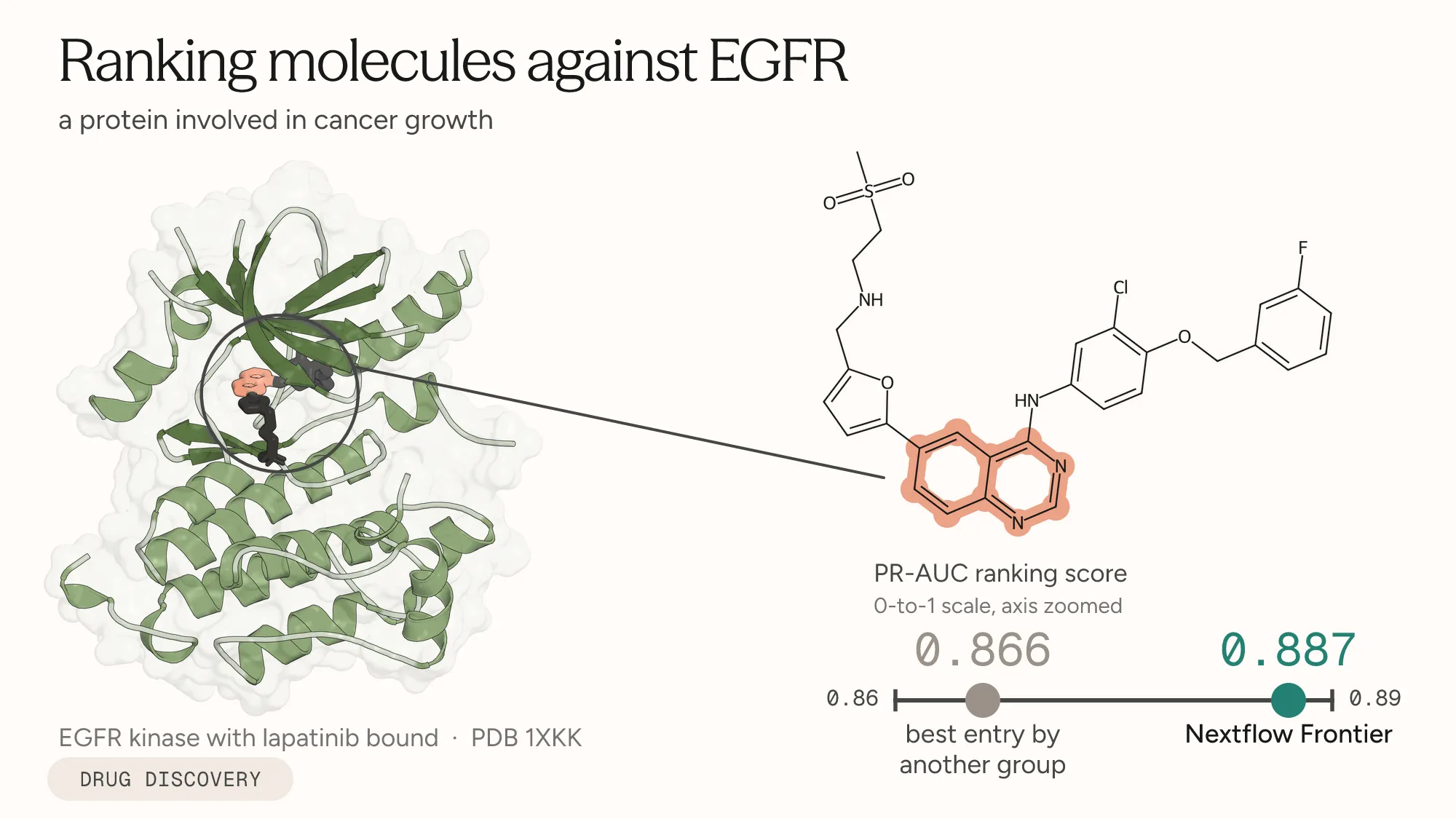
In this BioML-bench task, the objective is to rank 144 candidate molecules based on their predicted binding activity against EGFR, identifying those most likely to act as potent inhibitors. The system learns from a training set of 496 molecules with known active or inactive labels (see our EGFR blog post), where the test molecules feature distinct core chemical structures to challenge model generalization. Performance is evaluated using the Area Under the Precision-Recall Curve (PR-AUC), where a score of 1.0 represents a perfect ranking of active over inactive compounds.
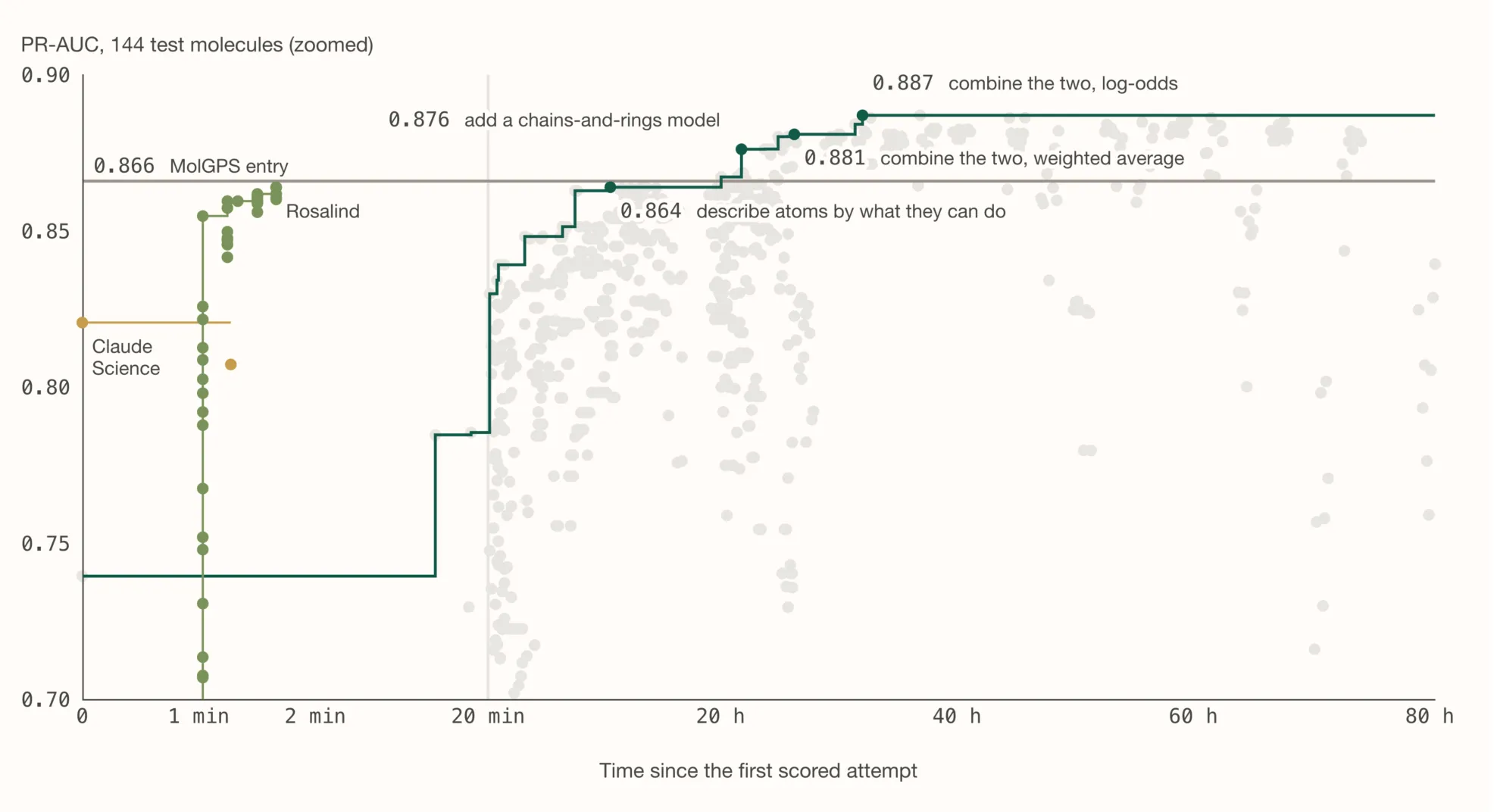
On the EGFR task, Nextflow Frontier ran for about 32 hours and gradually improved its score to a top mark of 0.887. This surpassed both Rosalind (0.864) and the previous leaderboard best, MolGPS (0.866; Sypetkowski et al. 2024).
The improvement came from evolving how the data was represented: early models used basic chemical fingerprints describing atoms by element, while later iterations described atoms by chemical role (reaching 0.864) and incorporated a second model focused on ring systems and connecting chains to hit 0.887.
Because Nextflow Frontier selected the best-performing model across 820 attempts on the same 144 test molecules, we statistically resampled the test set and re-scored the exact predictions found by Nextflow Frontier. This gave us scores between 0.73 and 0.99, making the reported 0.887 top score plausible but highly variable. Since MolGPS is a billion parameter network, we could not realistically put it to the same test.
Both Rosalind and Claude Science stopped within an hour. Rosalind built molecular fingerprints from SMILES strings and used grader feedback to select and tune a blend of logistic and tree models. It reached PR-AUC 0.864 after 51 scoring calls in about three minutes. Claude Science selected a blend of fingerprint models using scaffold-grouped cross-validation, then checked its candidates with two grader calls. It submitted PR-AUC 0.821 after about 8 minutes.
See Harbor Hub for Rosalind’s and Claude Science’s scored attempts.
Both Rosalind and Claude Science ended their runs voluntarily without hitting time limits. On EGFR, Rosalind stopped after noting its latest gains were marginal, while Claude Science stopped after two scoring calls without giving a reason.
Nextflow Frontier treats each result as the starting point for the next experiment. Nextflow makes that practical over days by scheduling the work at scale, recovering from failed jobs and recording what produced each score (Di Tommaso et al. 2017). This theoretically infinite discovery loop is the key to its notable outperformance.
A transparent, guidable system
Agents are notorious for producing large text artifacts. This puts a substantial verification burden on scientists. In the typical setup, scientists need to scroll through thousands of lines of text in a linear chat interface to find why certain decisions were made, or if solutions match what agents say the programs do.
Nextflow Frontier, on the contrary, solves this problem through a user interface built deterministically based on the actual scientific question at hand. This allows users to navigate through the information efficiently and steer the system by proposing new research directions and ideas as the system is running.
The goal of this interface is to provide highly efficient scientific transparency and guidability. Perhaps there is a day where black box models do everything perfectly and obviate the need for the scientist, but in the meantime Nextflow Frontier is designed to put the scientist at the active center of the discovery loop.
To be clear, during this benchmarking exercise, to provide a fair comparison, Nextflow Frontier’s user interface was disabled and we relied solely on the system’s autonomous capabilities.
Why Nextflow Frontier can run longer
At first glance, getting one of the LLM platforms to run longer looks like a simple adjustment that would erase Nextflow Frontier’s radical outperformance. We’d argue that deeper differences between the systems make it harder than it appears.
The fundamental difference is that Nextflow Frontier is a full discovery system that uses LLMs but is not beholden to their intrinsic limitations. LLMs suffer from: context rot, as longer inputs drift away from the training distribution; a strong propensity to latch on to early effective angles, which explains the huge jump you see at the beginning of Rosalind and Claude Science’s efforts followed by radical stagnation and early completion; reinforcement learning systems that are oriented towards binary tasks and thus don’t reward sustained effort past a viable first solution; training against binary problem spaces such as math and code, as opposed to biology whose rewards systems tend to be gradations.
All of these result in the LLM systems quickly latching on to early solutions, followed by activity that makes that first solution more complex, further undermining ultimate performance. And this isn’t a box you can easily prompt your way out of given the profound impact of training techniques on model behavior.
From a design perspective, it is the opposite with Nextflow Frontier, which uses LLMs to execute tasks such as research steps. The system as a whole is driven fundamentally by algorithms designed to match the gradient nature of biology, balancing exploration and exploitation.
To state this plainly, Nextflow Frontier uses specifically designed algorithms that aren’t agents to go around known LLM issues.
Validation at scale
The other notable difference between the LLM systems and Nextflow Frontier has to do with how experimental validation is actually executed. This is where Nextflow Frontier has the most notable advantage.
In the LLM systems, the science and the compute infrastructure run through the same system, clouding attention. For example, to get Claude onto a GPU cloud you have to explain literally everything about it in the prompt; Anthropic’s binder-design prompt is about 16,000 words and two-thirds of that is orchestration and operations.
In the BioML-bench test, Rosalind and Claude Science had to deal with finding and using the right tools to run their experiments, and they are not particularly skillful at this. It’s quite a different type of skill than other scientific steps in the discovery process, such as research summarization and hypothesis development.
Distinctively, Nextflow Frontier is designed to separate the science from the infrastructure. Nextflow itself is the premier compute orchestration framework for computational biology. So, as Nextflow Frontier develops intelligent scientific hypotheses for experimentation, LLMs represent those ideas as Nextflow pipelines, which then run at scale through Seqera’s platform.
This matters for reasons far beyond compute efficiency. In computational biology, how you write pipelines determines what you learn. As an example, if you write a pipeline with a single process and all the ideas inside this process, you can’t separate the key ideas and determine (and score) their impact. Learning is minimized by this approach, even if it seems at an LLM’s first glance like the more efficient way of approaching a problem.
Nextflow Frontier, to continue with this example, decomposes pipelines into distinct processes to allow for precision testing of each element of a given idea; this allows for much more intelligent iteration and hill-climbing.
In summary, because Nextflow Frontier is a complete closed-loop discovery system that uses LLMs but isn’t itself an LLM, it is able to more comprehensively match the optimal scientific discovery process in its design. The result of this is dramatic outperformance across a wide variety of computational problems.
Caveats
Here, we evaluate all three AI scientists based on how well they fulfill the contract. Which means, how well can AI scientists find solutions that maximize performance on the evaluation set?
We still need to build that evaluation set as a faithful biology digital twin, and Nextflow Frontier has been designed to surface the right information to help scientists refine this across experiment rounds.
In this case, we find that some BioML-bench tasks are not faithful representations of the biology and thus get quickly saturated by AI scientists. We mitigated this effect by closely verifying solutions and by repeatedly reshuffling the split between training and evaluation data, retraining each time to see how much the score changes.
In our work with ALLOX, we iteratively refined the experiment’s design, which led to models outperforming the current state of the art on unseen data.
Summary
Given the same tasks and the same freedom to keep experimenting, Rosalind and Claude Science usually settled on an answer within minutes. Nextflow Frontier kept running, scoring and recording experiments for days. It ranked highest in all four areas and matched or beat both systems on every scored task.
Those days represent compute time, not scientist time. The search runs unattended and in parallel, and every attempt is recorded with what changed and what it scored. With Nextflow Frontier, the scientist can step in at any point to review the record, trace where each gain came from and steer what gets tried next.
Richard Hamming drew the line between science and engineering like this: “In science if you know what you are doing you should not be doing it. In engineering if you do not know what you are doing you should not be doing it” (Hamming 1997). An engineering task ends when the code runs and the tests pass. Rosalind closed its EGFR run exactly that way: “Done. I wrote and verified the final candidate.”
Nextflow Frontier, on the other hand, acted on the model of science: it went on improving its score on the same task for more than a day. Stopping at “it works” can be good engineering. But in science you don’t know where the best answer is until you’ve looked, so the work is to keep trying ideas, check each one, learn from the results, and build deeper and deeper understanding. Nextflow Frontier is designed to do that for as long as the problem needs at any scale. As such it ushers in a new era of actual agent science as opposed to agentic coding applied to science.
Methods
Common setup
Nextflow Frontier, Rosalind and Claude Science were given the tasks in the same format:
- A public S3 bucket with training data, training labels and testing data
- Instructions on the task at hand
- An endpoint to score predicted testing labels against true testing labels
Exact splits were determined by BioML-bench. For imaging tasks (from Kaggle) this split differs from the prior leaderboard, the exact reported percentiles might be inaccurate. However, all three systems were always benchmarked against the same exact setup.
Rosalind and Claude Science each ran in a container with four CPUs and 16 GiB of memory. On the four imaging tasks, both also had access to an AWS Batch queue offering single-GPU L4, A10G or T4 jobs, configured with a shared capacity of 32 vCPUs. A separate CPU queue was configured for 64 vCPUs.
All three AI scientists could call the grading endpoint at any point without limits and were not given any time limit besides a generous task-dependent Harbor limit to prevent idle compute cost on our infrastructure.
We removed a spatially variable genes task because the public data contains hidden test answers.
Rosalind
Rosalind used OpenAI’s Codex agent version 0.161.0 with GPT-Rosalind-5.5 model at default high reasoning effort. We used Harbor (Harbor Framework Team 2026) to deploy Rosalind to a virtual machine with 4 CPUs and 16GB of memory. The Rosalind and Claude Science runs, including every scored attempt, are public on Harbor Hub.
Claude Science
Claude Science used version 0.1.67, with default Opus 5.5 at medium reasoning effort. Opus 5.5 biology safeguards triggered on 8 tasks, the work continued on Opus 5 instead.
References
- Di Tommaso P, Chatzou M, Floden EW, et al. (2017). Nextflow enables reproducible computational workflows. Nature Biotechnology 35, 316–319. doi:10.1038/nbt.3820
- Hamming RW (1997). The art of doing science and engineering: learning to learn. Gordon and Breach.
- Harbor Framework Team (2026). Harbor: a framework for evaluating and optimizing agents and models in container environments. Zenodo. doi:10.5281/zenodo.20953922
- Miller HE, Greenig M, Tenmann B, et al. (2025). BioML-bench: evaluation of AI agents for end-to-end biomedical ML. bioRxiv. doi:10.1101/2025.09.01.673319
- Sypetkowski M, Wenkel F, Poursafaei F, et al. (2024). On the scalability of GNNs for molecular graphs. arXiv:2404.11568. arxiv.org/abs/2404.11568
Interested in Nextflow Frontier?
Nextflow Frontier is a closed-loop discovery system built on Nextflow. It designs computational experiments, runs each one as a reproducible pipeline and learns from every result’s score what to try next, under the supervision of scientists.
Filed under Benchmarks
All posts